

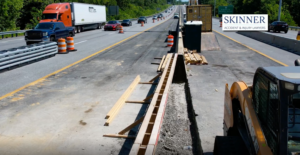
 If you have driven Interstate 81 through Berkeley County lately, you have sat in a work zone. As soon as one project wraps up, another one starts. This road carries huge daily traffic and a steady stream of tractor-trailers, so the work needs to happen. The trouble is that work zones create their own dangers. They are not always set up the way they should be.
Work zones that appear out of nowhere
Sometimes there is little warning before the cones start. A driver comes around a bend at highway speed and the lane is already shifting. Lanes move over. Temporary barriers sit inches from the white line. Speed limits change from one mile to the next. Put all of that together at 70 miles an hour, and there is very little room for error.
Cars and tractor-trailers in the same narrow space
I-81 is a freight route. Loaded trucks share these lanes with commuters, families, and delivery vans. In a work zone, everyone is squeezed into a narrower path with no shoulder to escape to. Construction vehicles pull on and off the road too, often at low speed. A loaded tractor-trailer needs the length of a football field to stop. That space disappears fast when traffic bunches up.
Why the crashes here get so big
Work zone traffic slows without warning. Some drivers follow too closely. Others are looking at a phone or a sign instead of the brake lights ahead. When the front of the line stops and the back of the line does not, you get a chain reaction. In Berkeley County, those pileups often involve several cars and one or more tractor-trailers. Construction is temporary. The injuries from a crash like that are not.
Drivers here come from all over
I-81 is one of the busiest freight routes on the East Coast. The truck beside you may have started the day in Pennsylvania. Local drivers headed to jobs in Virginia, Maryland, and Washington, D.C. use the same lanes. Plenty of people in a Berkeley County work zone have never driven it before.
Who is responsible for a work zone crash?
The other driver is not always the only answer. Work zones are supposed to be marked and set up a certain way. Warning signs are supposed to sit far enough back to matter. When they do not, that becomes part of the story. Trucking companies have their own rules to follow. Sorting it out takes the crash report, photos of the work zone as it stood that day, and often the truck’s own data.
A work zone crash has more moving parts than an ordinary wreck. A trucking company may be involved, sometimes a contractor, and an insurance adjuster who already has a theory about what happened. We have spent years on car accident and truck accident cases along this stretch of I-81. Contact us, and we will tell you straight what your case looks like.
Our Most Dangerous Intersections series looks at other spots where we keep seeing the same crashes. It is worth a few minutes with the newest driver in your house.